Hiển thị các bài đăng có nhãn miscellany. Hiển thị tất cả bài đăng

Thứ Hai, 15 tháng 8, 2016

Zombie Urbanism

Jonny Aspen, Associate Professor at the Institute of Urbanism and Landscape in Oslo, Norway, coined the term "Zombie Urbanism" in 2013 to describe the way many urban environments are being designed today. I like the term, so I got in touch with Aspen and asked him about it--and how it applies to the redesigning of New York City, including the High Line, Hudson Yards, Times Square, and the new Astor Place.


Astor Place


Q: Can you give a definition of what you call "zombie urbanism"?

A: I’ve coined the concept in order to encircle what seems to be an increasingly more prevalent, and increasingly more worrying, phenomenon in contemporary urban development, namely the cliché-like way that many developers and designers talk about and deal with urban environments in general and public areas and places more specifically.

On the one hand I use it as a reference to what seems to have developed into an increasingly more homogeneous discourse, globally speaking, on what is believed to be important features of the so-called “creative city.” It’s a discourse that highlights the importance of cultural institutions, state-of-the-art architecture, and well-designed public places.

The concepts in use remind me of what the famous German sociologist Ulrich Beck has labeled “zombie concepts,” with reference to the social sciences. They are concepts that still are very much in use, but actually no longer fit the reality they intend to describe. As such the concepts are like the living dead, they are alive in our heads and our language, but not any longer useful for making precise propositions about the reality of the city.

On the other hand I use the concept of “zombie-urbanism” as a reference to how I experience many of the urban environments that come out from such a discourse, as built environments. What we can see is a kind of staged urbanism in which there is no room for irregularity and the unexpected, a well-designed, neat, and tedious urbanism based on a simplified understanding of the urban combined with more ideal aspirations about creating “living” and “people friendly” cities. You can see it in quite many urban redevelopment projects all over the world. Other examples can be found in strategies for remaking public places and plazas, such as for instance the recent developments of Times Square in New York.


Times Square


Q: What do you think is allowing zombie urbanism to spread across western cities today?

A: In general, the phenomenon is related to the current regime of neoliberal urban development and planning. This is a regime in which both developers and urban politicians quite shamelessly use urban features such as public squares and plazas as means for selling, marketing and branding. As such quite many aspects of “urbanism” have become subject to strategies of commercialization and capital manipulation. This development is of course also related to the seemingly never-ending spread of gentrification, or to what Neil Smith calls “generalized gentrification.”

The same goes, of course, for tourism, as an increasingly more important global industry.

Another important aspect, if not a cause in itself, is that quite many planners, architects, and designers seem to profit from such a development. They seem to have found themselves a new niche in designing urban tableaus of various kinds.


High Line, via urban75


Q: Where did you see these developments during your time in New York City?

A: I saw such developments most clearly in newly built areas, and especially in ones that contain public spaces and facilities. One such development is the Hunter’s Point South Park in Queens. I am particularly thinking about the promenade along the East River. Everything here looks clean, tidy, and civilized. The promenade is also equipped with well-designed chairs and benches. So everything seems in order, everything seems to make for a lively urban area. But even though the scenery is outstanding, especially the view towards Manhattan, the whole area feels dull and boring.

This is what I mean by zombie urbanism. Everything looks nice and urban, but in terms of social life, it’s rather sterile and dead.

A similar example can be found a bit further down the river, on the Manhattan side--the East River Waterfront Esplanade, especially the new Pier 15 that opened in 2011. The whole development is imbued with a well-meant rhetoric of making the waterfront accessible for all people, improving qualities of life, sustainability, and community programming. But again, the end result seems rather lackluster and limited. My impression is that most of the esplanade primarily is made to attract conventional recreational interest of tourists and middle-class groups that now seem to have taken over most of Manhattan.

Much of what’s here said also goes for the High Line and the Times Square redevelopment, though those stories probably are a bit more complex.

Besides such examples, the most obvious features of what I call zombie urbanism can be seen in many plans and prospects for future buildings and developments, especially when it comes to visualizing all the splendid qualities that the project allegedly will bring to the area when completed. Visualizations of public space qualities seem to have become increasingly important in this respect. In this way planners and developers deliberately use public space qualities as a way of both legitimizing and branding a future project. By highlighting all the fantastic urban qualities a development will bring to the neighborhood or to the city as such, any objections and criticisms that people might have towards the project are also curbed. Because who could really be against the planning of a new public space or a playground?

This has become a global trend. Just take a look at the plans for the new development at South Street Seaport or Hudson Yards in Manhattan.


The "Seaport of Tomorrow"


Q: What are the hallmarks of zombie urbanism? How do we recognize it when we see it?

A: This is harder to answer, because it’s not so that zombie urbanism is something that can be clearly pointed out as something that exists like a thing in the world. Zombie urbanism is a theoretical concept that, in the way I seek to use it, represents an effort to capture and put into words some important changes in the way our urban environments are produced as well as experienced.

For me, the latter issue of how we experience the urban world is especially important. This is what I’m trying to find ways of describing. Issues of feelings, affects, and atmospheres then become important, though they are not easily captured or put into words. I don’t want to become too philosophical about this, but the issues here at stake also relate to what each and one of us believe to be more or less genuine and authentic.

Why does the new Starbucks on the corner seem to be less authentic than the old coffee shop that it has replaced? It’s easy to pinpoint a range of issues and features that makes it so, but what it is that really makes the big difference might be harder to identify. Much the same goes for the topic of zombie urbanism. In general, my argument is that our urban life world increasingly seems to be staged in accordance with global clichés about urban environments and urban living. This is what worries me, and this is what needs to be further explored.


Astor Place


Q: Recently, in the East Village, Astor Place has been redesigned. This was years in the making. They removed part of the street, widened the central square, planted trees, put in concrete slab seating, and tables with umbrellas. It is now used by corporations like IBM and Citibank to hold “advertainment" events.

I'm pretty sure this is a prime example of zombie urbanism. But some would argue that it's a good thing--those slab benches and tables are full of people. How do we claim this is not an authentic and lively urban scene?


A: I agree that the remaking of Astor Place seems to be a good example of zombie urbanism. I would have to make some reservations due to the fact that I haven't seen the end result myself. But from what I can see from pictures and descriptions on the net, the makeover of the area resembles much of what I would call zombie urbanism. So what makes it zombie-like?

The most telling point is that the overall design solutions seem to be very generic. The whole place seems to play up design schemes for public places that are quite similar in many parts of the world. It is the same ingredients that are replicated all over: widened sidewalks, new seating, more plantings, upgraded lighting and so on, plus an attraction or two, may be an artwork or something, that apparently is to make the area stand out as something unique and special. My experience is that such places more often than not make for a fairly limited spectrum of public uses and activities.

City life is about encountering the unexpected and the unfamiliar. I'm not quite sure Astor Place will be the right place to visit in that respect.

Such forms of public design, even though many might see them as improvements, are damaging in that they block more creative ways of going about making public places. Instead of taking on the challenge of really involving people and working seriously with how to make places that are both socially mixed and inclusive, one settles with established urban design solutions, often prescribed by international consultancies.

When it comes to New York it might be that it's such a dynamic city, one can live or cope with a few zombie-like design solutions, such as at Astor Place, just because the places often will be put quite extensively to use. As such, the places themselves will continuously be in a state of flux and change, despite the way they are designed.

It's comforting to know that people will overrule the prescriptions of planners and designers. That's what urban living is very much about.


Astor Place

Thứ Hai, 7 tháng 3, 2016

Get Angry

If you're on Facebook, you know about the new "reactions," a set of emojis you can choose to react to a post. Instead of just "like," you can now express: Love, Haha, Wow, Sad, and Angry. You can probably guess that this is all about collecting emotional data for the purpose of advertising. But it also provides data to the individual user about how readers are reacting to their posts.

And that confirmed something I've long suspected about the emotional state of New Yorkers--at least the ones who follow Vanishing New York.


Last week, we experienced a number of losses in the city, especially in the East Village. Trash & Vaudeville left St. Mark's Place. St. Mark's Bookshop shuttered for good. The Stage restaurant announced it would not reopen. I posted the news on my Facebook page and people reacted. While the majority still used the old "like" button, many others opted for an emoji.

How do people feel about these closures? Most feel sad. And not enough feel angry.

Reacting to the news of The Stage vanishing, 22 people chose Angry while 43 chose Sad. For the closing of 69 Bayard in Chinatown, 15 were angry while 26 were sad. For Trash & Vaudeville, 80 were angry and 148 were sad. For each post, it seems that twice as many people choose sad instead of angry.

And that's not good.


While sadness is certainly a natural reaction to loss, the emotion often comes with resignation and hopelessness. It can collapse on itself, coupling with a sense of futility, and may lead to apathy. Sadness does not move anyone to take action. Sadness curls into a ball. Or it sits on the couch, clicks buttons, eats snacks, and says, "What's the point?"

Anger, on the other hand, is energizing. It helps people to move, to fight, to stand up and say "No!" Anger can lead to action and creativity. Anger can lead to positive change.

While I understand the despair and its attendant feelings of powerlessness--I feel it, too--this city needs angry people. But every time I post news of a closure, I watch the Sad faces multiply twice as fast as the Angry faces.

I suspect that you feel more sad than angry because you think that all these losses are inevitable, part of the natural cycle of normal urban change. Listen: These losses are not inevitable and they are not natural. They are the direct result of decades of public policy. And policy can be changed--but only angry people can change them.

We can act up against the homogenization of our city. We can act up against hyper-gentrification. We can act up against rising rents and evictions. It is not futile. We are not powerless. But you're going to have to get angry. You're going to have to muster something better than a sad face.


Go to #SaveNYC and Take Action. Send a letter. Start a group. Organize an event, a protest, a rally. Make public art. Even simpler: Just talk about what's happening in a different way.

This is important. Stop saying "it's sad." Stop saying "New York is always changing." I'm sick of hearing that one. While there is of course truth in that statement, it is being used to disempower you and distract you from the truth. While we're on the topic, you are not "just being nostalgic." You are watching a city die. It is a global pandemic. It is real. And it has been engineered by the people in power. Doesn't that piss you off?

We have to change the discourse around this or we will not have a city tomorrow. At the very least, shift your emotions. An emotional shift can take us in a different direction. Get angry. Then tell your friends and families and coworkers that you're angry. Tell them that these changes are not natural. Tell them you're not just being nostalgic. And tell them what can be done to save the city.

Let New York see your angry face. It's now or never.


Thứ Hai, 28 tháng 12, 2015

2015 Vanishings

At the end of each year, since 2007, I offer a list of places that vanished during the year. These are the ones I covered on the blog, but there were many more. Please add those not included here in the comments. Click the highlighted name to go to the post for more info. And for previous years' vanishings, just scroll down to the bottom.


Avignone Chemist
Since 1832. Killed by its new landlord, a hedge fund that tripled the rent.

The Unicorn
Just 21 years old. Another piece of gay Chelsea gone. Rent increase.

La Parisienne
Since 1950. Cause of death unknown.

Winnie's
28 years in Chinatown, beloved by gangsters and karaoke kids alike. Could not get a new lease from the landlord.

Moran's
Since 1957. Building sold, a new restaurant took over the space.

Caffe Dante
100 years old. Sold by the owners.


Penn Books
Since 1962.

Eagle Provisions
Over 75 years old. Owners opted to close in a neighborhood where they no longer fit.

Louis Shoe Rebuilders
On the site of the Empire State Building before the Empire State Building was even built, the shop had been here since 1921. After 94 years, the landlord did not renew the lease.


Rudy's Music Stop of 48th Street
Music Row is dead and dying.

Tribeca Cinemas
Since 1996. Building sold for development.

Charlie Mom
Since 1983. Death by rent hike.

The Palm Restaurant
90 years old--and gorgeous. The owners sold the building. The cartoon murals were destroyed.


Cafe Borgia II
Since 1975. Lost their lease.

Market Diner
Since 1962. Sold to the Moinian Group development corporation, closed for demolition and a new luxury tower.

La Taza de Oro
68 years old. Forced to close by the city due to bricks falling from neighboring building. After several months of losing income, the owners decided they could not reopen.

La Lunchonette
28 years old. Closing New Year's Eve. The landlord sold the building for more High Line development.


Previous Years' Vanishings:
2007
2008
2009: Parts 1, 2, 3, 4
2010
2011: Parts 1, 2, 3, 4
2012
2013
2014

Thứ Tư, 23 tháng 12, 2015

Bickle Hawk

This is the mohawk wig that Robert DeNiro wore to play Travis Bickle in Taxi Driver.


If you want to commune with it "in person," you can find it at the Museum of the Moving Image.

Merry Christmas.

Thứ Hai, 14 tháng 12, 2015

Nostalgia Train

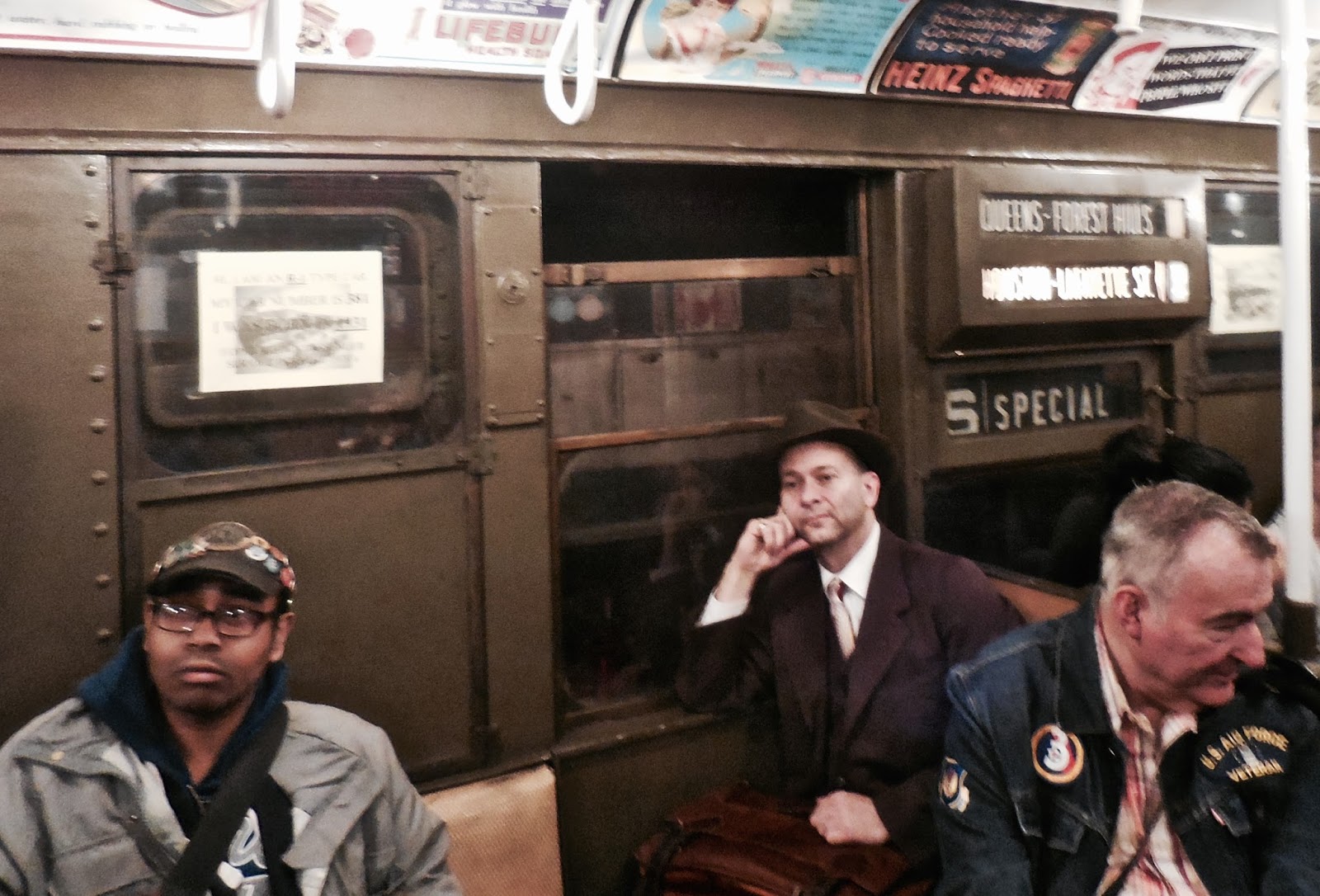
Riding the Nostalgia Train sounds like something you do when you're lost in reverie and memory, pining for what used to be. If that's what it is, then many New Yorkers are casting backwards through time on Sundays this month, riding antique subway cars along the M Line, from Second Avenue to Queens Plaza and back again.

The people on the Nostalgia Train are a different breed.


Some come dressed in period costume, Depression-era hats and coats, shoes and neckties, dark lipstick shades of another epoch. These otherworldly anachronisms dance on the station platform to the music of a little swing band, the slick-haired singer crooning "Night and Day."

Others come in MTA paraphernalia, railfans dressed in t-shirts and knit winter caps proclaiming their favorite subway line. The F and the 6 are tops. One young man sits grinning, running through a near constant patter of conductor announcements. He's got the script down and compulsively, giddily recites its length and breadth. "This is Broadway-Lafayette," he calls out. "Transfer is available for the 6 train. Stand clear of the closing doors." Another young man, wearing an Amtrak t-shirt, holds his iPhone by the open door between the cars, audio recording the clickety-clack in the dark tunnel's roar.


Haloed by warm incandescent light bulbs, an older man stands and pontificates on the state of today's New York, city of yuppies, cell phones, and drunk Santas: "Is this the city you and I were raised in? It's become alien. I have no feeling for it anymore. It's scary!"

But no one listens. They'd rather pretend it's the past.

Retired motormen trade stories. Clasp hands. Greet each other warmly, saying, "Hey, I ain't seen your ugly mug for a hundred years."

Among the fanatics and nostalgics, other New Yorkers climb aboard, acting like the everyday subway riders they are--tired, bored, going to work, coming home from a long day already. They've got no time for reminiscence.


The Nostalgia Train doesn't sound or feel or smell like today's bright and whispery subway cars. Heavy in its bones, it broadcasts a loud symphony of sound, rattling and wheezing through the underworld. Inside, ceiling fans whiz overhead. The air is olive drab or else some shade of sea foam.

Open windows let in the smells of the tunnel, which shift from swampy organics to a fragrance you'd swear was burnt buttered toast.

Soot flies in and lands in your eye. In these old cars, you are not sheltered from the city. You are joined to it.


There is no stillness here. The rattan benches bounce your spine up and down as the jolting car keeps all bodies in motion.

But the best part comes when the train dives beneath the East River and launches forth to Queens. The driver lets out the throttle, like letting loose the reins of a horse, and the whole thing torpedoes ahead. It dives deeper, faster, jerking from side to side, shuddering in its bolts. A gritty wind blasts through the openings, strong enough to knock off a hat, if it tried.

In this unbridled speed, the riders are giddy. It is a relief to feel the city thrumming in your gut, to not be insulated from it, to not be held in some sterile, hospital-lit tube.

This feels real. This knocking around. This sucking down the filthy wind. This robust mechanical jolt.

This is New York.


Thứ Tư, 9 tháng 12, 2015

SantaCon

SantaCon is coming. I hope to avoid it. Here's a SantaCon repost from Christmas past:


On the downtown 6 train, on the day of Santacon.

Doofus Tourist Man: Hey, what's up with all the Santa suits?

Santacon Man: It's New York! Woo!

New Yorker Woman: (intervening) It's called Santacon. People dress up like Santa and get drunk.

Doofus: Awesome! So they just walk around shit-faced all day? That's awesome.


New Yorker: No, it's not awesome, actually, it's pretty horrible.

Doofus: What are you, Ebenezer Scrooge?

New Yorker: Yes, I am.

Doofus: But it's New York!

New Yorker: (getting upset) You're telling me it's New York? You're telling me?

Doofus: What, you live here?

New Yorker: Yes, I do.

Doofus: But you're not from here, originally.

New Yorker: Yes, I am.


Doofus: So you see this Santa thing all the time?

New Yorker: Yeah. And it gets old pretty quick.

Doofus: (giving up) Huh. Well, I guess it's a local holiday. Like Kwanzaa.


Thứ Hai, 13 tháng 7, 2015

Bad Old Days

There's a panic spreading across a certain sector of the city. Pre-Giuliani New York is coming back!

For mega-realtor Robert Knakal at the Commercial Observer, crime is "increasing like wildfire." And along with all the "shootings and murders" comes "an alarming degradation in quality of life issues, which mayors Giuliani and Bloomberg worked so hard to improve." The terror? Squeegee guys and homeless people.

All of this, Knakal argues, is bad for tourism and the high price of commercial real estate.


"Fuck You Pay Me" guy, with anarchy tattoo, Times Square

The New York Post is having a field day with this idea that New York is experiencing an increase in its homeless population.

John Podhoretz is worried about the degradation of the urban streetscape. He wrote about high-rent blight, all those shuttered businesses sitting dead due to insane rent hikes, then argued about an apparent increase in aggressive "panhandlers from the neighborhood’s bad old days."

Tom Wilson is worried about homeless people pissing in the streets and sleeping outside Victoria's Secret, where they drive away the customers. “It reminds me of the pre-Giuliani era,” said one Penn Station commuter. “The police aren’t chasing them away anymore.”

A whole team of Post writers are worried about Tompkins Square Park filling up with "herds" of vagrants. “I really don’t enjoy the beauty of the park anymore because I’m too scared to walk through it,” said one NYU student.

(When will the Post pick up on the purse and iPhone snatchings in the East Village?)

In sum, the increased presence of homeless people means: 1. High rents will come down, 2. Customers won't shop at suburban chain stores anymore, 3. The tourists will finally go home, and 4. NYU students will be afraid of the East Village.

How is any of this a bad thing?

The panic has even gone national. "Beggars everywhere," says right-wing scaremonger Bill O'Reilly, who believes that homelessness "exploded" under Bill de Blasio. "And that is a totally different change from the Bloomberg administration. They're wiping your windows, they're following you down the street."

It's "anarchy" says O'Reilly. Anarchy!


"Cash" outside Chase Bank, E. Village

We saw this same panic back in 2008, after Wall Street's crash. Everyone was wringing their hands about the "bad old days." They did not return and they're unlikely to do so today.

Also, let's get it right. The increase in homelessness was a Bloomberg problem.

The homeless population exploded during the billionaire mayor's reign, with numbers unmatched since the Great Depression. Bloomberg increased homelessness in the city by withholding affordable housing. For decades, people who applied through the city’s shelter system were given priority for federal housing programs like Section 8. Bloomberg cut them off. In a paranoid fantasy, he believed in a “perverse incentive” for homelessness, that New Yorkers were making themselves homeless just to get cheap housing from the government. He replaced the Section 8 priority with a short-term subsidy that soon became a revolving door, forcing the homeless out of their new homes and back on the street.

Bloomberg complained that too many people who didn’t need help were taking advantage of the city’s shelter system. On WOR radio he said, “You can arrive in your private jet at Kennedy Airport, take a private limousine and go straight to the shelter system and walk in the door and we’ve got to give you shelter.”


"Cash" in cuffs, Ludlow Street

What gives some people anxiety is the increased visibility of the homeless. Well, this happens every summer. Homeless people are outside because it's warm.

It's also possible that cops are doing less hassling of the homeless, not hauling them off to Rikers simply for existing. And that's not a bad thing, either.

But keep up that scaremongering, fellas. You're doing a big favor for those of us who want our city back, who want an affordable, more interesting New York that isn't controlled by billionaires, tourists, and NYU students. By the way, have you heard of this handy little pamphlet called "Fear City"?


Thứ Sáu, 12 tháng 6, 2015

Enormous Eye

Last week, author and journalist Amy Rose Spiegel asked me to make a diary of my Saturday for her site Enormous Eye, where writers record the details of their Saturdays, including people like Luc Sante and Tavi Gevinson, and a whole bunch more.

Here are a few photos to accompany my Saturday diary, which you can read here, should you so desire.


Thứ Năm, 5 tháng 3, 2015

#SaveNYC

Last week, I put up a new website: #SaveNYC. It came out of the SaveNYC Facebook group, which came out of the fight to save Cafe Edison. It felt like we had some momentum there and I wanted to keep it going, to bring together many voices in support of legislation and zoning to protect the city's beleaguered small businesses and vanishing cultural fabric. Maybe, with enough voices shouting together, City Hall will listen.


#SaveNYC has already gotten media attention--from DNAInfo and The Atlantic's Citylab, with inquiries from major television news. But we need more of you on the site, telling City Hall what you want to see happen.

There are two ways to get your voice heard on #SaveNYC: Make a video statement or write your statement

A video statement will have more of an impact--and it's easy to do. It requires a simple camera--a point-and-shoot or the one in your smartphone will do the trick. Then upload it to Youtube and send in the link. No need for fancy edits. It takes 5 minutes.

If you're camera shy, do it as a voiceover. Do it as a group. Hold a sign over your face that says #SaveNYC while you talk. Be creative. Just be sure to make it a statement direct to the powers that be. (If technology makes you nervous, ask a friend to film you. Children and young people are good at this stuff. If you're not afraid of technology, offer to film your Luddite friends and older people.)

Another helpful thing you can do is to film your local small businesspeople and ask them to make a statement to City Hall.

If you're tired of sitting around complaining while nothing changes, here's your chance to be heard. The more voices that come together, the more they'll have to listen.


Thứ Ba, 3 tháng 3, 2015

Dogs & Papaya

Last week, the Observer published an Op-Ed entitled "The Tyranny of Nostalgia." In the article, Anthony L. Fisher essentially named me as Nostalgia Tyrant #1. (If only!) There's so much to argue against in the piece, but I've said it all before, in depth, a million times. So I'm taking the Bartleby route on this one.

That said, one line has stuck with me: "Not too many people eat hot dogs anymore." This is the real reason, says Fisher, that Gray's Papaya was booted from 8th Street and replaced with a Liquiteria. We've been hearing this argument lately. It goes: Tastes have changed, "people" aren't going to "those places" anymore, and that's why they vanish. But there is one reason why Gray's Papaya closed--the landlord nearly doubled the rent. Rent hike or denial of lease renewal is almost always the reason our favorite old places close.


New Yorkers eat hot dogs. Unfortunately, low-priced everyday franks--without the artisanal bells and whistles--can't pay the new exorbitant rents. So we're left with fewer and fewer hot dog stands.

From my count (am I missing any?), Manhattan now has just eight spots to grab a couple of hot dogs and a papaya drink, way down from a once plentiful number. I went to all of them* and ordered the same meal: Two dogs (with mustard and relish) and a 16-ounce papaya drink. The ever-present "recession special," which goes for about 5 bucks.


Papaya King, 179 East 86th Street

The grandaddy of them all, Papaya King opened on this corner in 1932. It was founded by Greek immigrant Gus Poulos. They have the best neon sign. Check out this video (mark 6:16) in which Jerry Rio interviews Peter Poulos on the history and importance of Papaya King.


Back in 1991, the New York Times wrote: "What would be a non sequitur in cities like Omaha and Wichita -- or even Washington and Boston -- is now as unshakable a pairing in New York as as corned beef and cabbage or pastrami and rye. These days it is hard to find a hot dog shop in some parts of the city that does not promote papaya and other tropical fruit drinks with its hot dogs. Almost anywhere one looks there is Papaya King, Papaya Heaven, Papaya Paradise, Papaya Place, Papaya Circle, Papaya World, Original Papaya, Gray's Papaya, Mike's Papaya or Papaya Jack. No doubt there are more."

And the King started it.

This spot's location on the Upper East Side means that men drive up in luxury cars, jump out, get their dogs, and go. In between, its everyday Joes--construction workers, taxi drivers, panhandlers. Women eat hot dogs, too, but I saw far more men in these places.


Papaya King, 3 St. Mark's Place

This outpost of the King opened quite recently, in the spring of 2013. There were others, including one in Times Square that closed sometime in the early 2000s, but now there are just two. Plus a roving food truck. This one always seems kind of quiet. Maybe people don't eat hot dogs on St. Mark's Place.


Gray's Papaya, 2090 Broadway at 72nd St.

Gray's opened on the Upper West Side in 1973. It was founded by Paul Gray, a former partner in Papaya King, who broke away to do his own thing.


There once were more Gray's Papayas, including the still-missed location at 6th Avenue and 8th Street. As previously mentioned, it closed in 2014 thanks to a rent hike, and has been replaced by a Liquiteria.

This dearly beloved spot is busy, even in bad weather. Standing room only, there's no room left at the counters. Here, a homeless man loiters, panhandling for change. As long as he's not getting aggressive, he's tolerated and given a few coins, which he spends on hot dogs.


Papaya Dog, 14th St. and 1st Ave.

With four New York locations (there's a fifth in Hoboken--am I missing any?), there are more Papaya Dogs today than there are Papaya Kings and Gray's Papayas. Still, Papaya Dog goes uncelebrated, treated like the poor stepchild of the elder two (both of which have Wikipedia pages, while Papaya Dog does not).

The Papaya Dogs are a bit rougher around the edges. But this one on 14th and 1st breaks with the standing-only tradition and offers a couple of booths for sit-down dining.


Customer traffic is constant at the Papaya Dogs. School kids flock to them. Workers stop in during their lunch breaks. Laborers pull up their rumbling dump trucks and garbage trucks and plumbing repair vans, and hop out in smudgy coveralls for "two to go with ketchup and onions" or "gimme two with mustard and sauerkraut," a cup of papaya or coconut champagne to wash them down.

At all the hot dog stands, the crowd is racially and socioeconomically diverse. Many people of color are eating hot dogs. Immigrants are eating hot dogs. Tourists and students are eating hot dogs. This is not a food of so-called nostalgia. It is a democratic food of affordability and accessibility. 


Papaya Dog, 6th Ave. and Cornelia St.

This particular Papaya Dog won't last much longer. It's in a building bought in 2013 by a luxury developer. They've got plans to kick out all the funky, long-time little tenants and replace them with national chain stores.

Dog-and-papaya places are especially vulnerable because they tend to be located on corners. That's prime real estate for banks and other national chains. Landlords know this and hike the rent, or simply kick them out.


Papaya Dog, 5th Ave. and 33rd St.

This one's the smallest of all the dog-and-papaya joints, with barely a sliver of counter space for dining behind a trash can. They've got a deal with the pizzeria next door, though, and you can bring your meal over there. At lunchtime, the tables are bustling.


Papaya Dog, 9th Ave. and 42nd St.

This corner spot was also rumored to be vanishing. It's in the old Elk Hotel (go inside the hotel here), which was emptied and put on the market awhile back. But, somehow, the Papaya Dog is still standing. This one also has tables and chairs.

Among the young tourists and families, an elderly woman sits at a table and applies her fire-engine red lipstick. Cops and taxi drivers hustle in and out.


Chelsea Papaya, 23rd St. and 7th Ave.

After the three big guys, a few scrappy papaya-and-dog joints have spawned and survived. Well, not really survived. And not really a few. The 21st century has been cruel. Hot dog stands started vanishing fast when everything else did. Rents went up and up. Yorkville's Green Papaya vanished around 2009. East Harlem's Frank's Papaya went sometime after 2008. Three Mike's Papayas died in the past few years. Many others folded around town.

But Chelsea Papaya remains, an oddball in the dog-and-papaya world, right down the block from the Chelsea Hotel. The window ledge gives you the perfect place to perch and watch the drama of the street unfold. Again the place is intermittently packed, with lines of customers jamming into the small space, coming and going quickly.


Mike's Papaya, 132 E. 23rd St. at Lexington

In my quest to dine at every dog-and-papaya place, I regrettably arrived at the last Mike's Papaya about two days too late. It's gone, closed "due to an unforeseen circumstance," according to the sign in the window.


There used to be a few Mike's Papayas (the Reade Street location vanished in 2012, and another at Broadway and 110th went in 2002). Then there was just this one by Gramercy Park.

We don't know what Mike's "unforeseen circumstance" was, but we can be sure that when the rent on all the dog-and-papaya places is doubled and tripled, it won't matter that they were busy and beloved. We'll hear journalists say that "Tastes have changed" and "People don't eat hot dogs anymore." Eventually, that statement will be true, but only because there will be nowhere left to find such a rare and affordable delicacy.


*I was already nearly finished with this post when the Observer op-ed came out. It took weeks to complete. I did not eat 16 hot dogs in one weekend.

Bài đăng phổ biến